Zebra medical newsletter JANUARY 2026

header-NL4

Dearest Zebra Medical Community,

anje-profile-circleIt’s been seven months since my surgery and my post:
My arm is not a pincushion.” Vascular access isn’t a small step in patient care. It’s often the difference between efficient treatment and unnecessary trauma.

The trauma still lingers. My husband had to come with me for a cholesterol test recently because my needle phobia is real – and DIVA status is likely a lifelong burden. A routine blood test should be simple. For some of us, it becomes a sweaty-palmed, veinhunting ordeal that ends in panic.

And in that vein (pun intended), thank you to everyone who attended our Midline Webinar on 13 August 2025. Our expert panel agreed: vascular access is no longer just technical – it’s strategic. The right line for the right patient is an imperative. For those who missed it, here’s the link: https://youtu.be/2yme7vZGHT4?si=WdfstIRfswmc2fO5
anje-profile-circle
But midlines are only part of the story. When medium-term access is required, especially beyond 30 days’ dwell time, we’re seeing a resurgence of PICC-lines as a viable option: less invasive than traditional central access, often less expensive, and increasingly relevant for the right patient and indication – with important provisos, especially around care and maintenance.

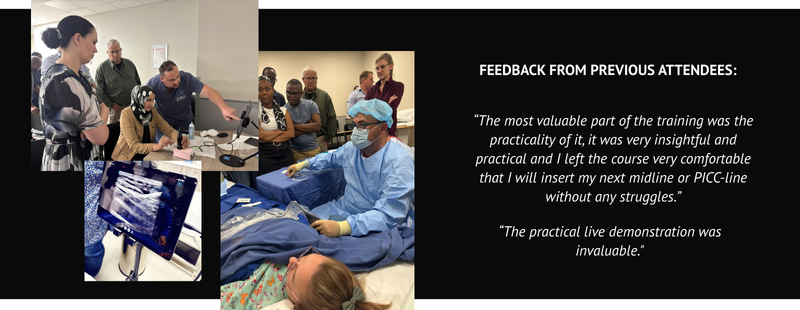
This month, we take the conversation further. We invite all vascular access enthusiasts to join Zebra Medical’s “Combo Midline & PICC-Line Course” with Dr Hugo Minnaar on: 21 January (Gauteng) and 24 February (Cape Town). To register: CLICK HERE or scan QR CODE in image.

Let’s keep elevating access decisions that protect patients, empower clinicians – and deliver Care without Compromise.

To PICC or Not to PICC?

by HUGO MINNAAR

I use a simple binary decision-making process when it comes to central venous access: avoid traditional central venous pressure (CVP) lines whenever possible – it is almost always in the patient’s best interests.

During the initial resuscitation phase, a critically ill patient usually requires a multi-lumen central venous catheter (CVC). When multiple vasoactive infusions, blood products, TPN, fluids, and antibiotics are being administered, a CVC is clearly indicated. However, very seldom is a second or third central line required beyond the initial ±14 days, provided the patient stabilises.

Once a patient is haemodynamically stable and receiving fluids, analgesia, and antibiotics only, there is no justification to continue with a more invasive CVC when a PICC-line can safely fulfil the same role – provided the nursing staff are properly trained in PICC care.

And in reality, there are far more reasons to use a PICC-line than not to.


My Rule of Thumb

If you have to change a CVP more than once – consider a PICC-line. Think of a PICC-line as a CVC inserted via the upper arm, but:

  • Less invasive
  • Lower mechanical risk
  • Safer over the long term
  • Suitable for prolonged therapy
  • Much cheaper in the long run

The major advantage?

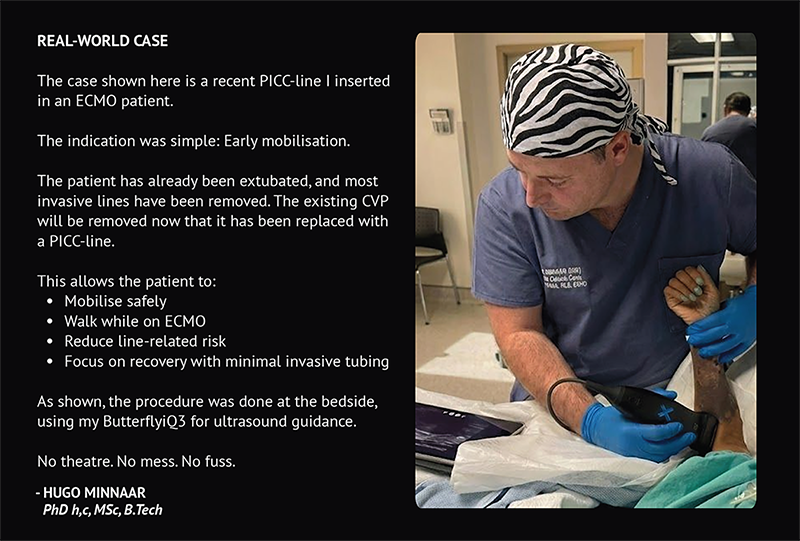
It can be inserted safely at the bedside using ultrasound guidance, without theatre time. I perform these insertions exclusively using ultrasound guidance, and I routinely use a 5 Fr dual-lumen PICC-line kit, which provides everything required for a controlled, sterile, and efficient procedure.

Who Is a Good PICC Candidate?

Any patient requiring central administration of:

  • Vesicant antibiotics
  • Chemotherapy
  • Total parenteral nutrition (TPN)
  • Central-only medications such as amiodarone


In these patients, a PICC-line allows delivery of central therapy while significantly reducing the risks associated with traditional CVC insertion.

Contraindications (Few, but Important)

PICC-lines have very few contraindications, including:

  • Local sepsis or infection in the arm
  • Recently inserted pacemaker on the intended side
  • Inadequate vessel diameter


Many of these challenges can be overcome with:

  • Axillary vein access with tunnelling
  • Femoral-inserted central catheter (FICC) with tunnelling to a cleaner, safer, more distal site away from the groin


PICC-Line Care Matters

Proper care is essential:

  • Daily saline flushing using the pulsatile piston technique
  • Dressing changes every 7 days
  • Strict aseptic handling


When cared for correctly, a PICC-line can remain in situ for 6-12 months without complication.

This is critical knowledge for nursing staff and often the deciding factor between success and failure.


Zebra Medical Newsletter2