Zebra medical newsletter December 2025

header-NL3

Dearest Zebra Medical Community,

anje-profile-circleThankfully, December has arrived. And although we are all looking forward to a bit of sunshine and some downtime, we are also bracing ourselves for the reality that comes with this time of year: busy roads and a tragic increase in vehicle accidents.

In those critical moments following a crash, when internal injuries are invisible to the naked eye, and often there’s more than one person requiring medical attention at the scene, what options do our first responders have? Time is of the essence. How do they perform rapid and accurate triage on the roadside to assess who needs the most urgent care?

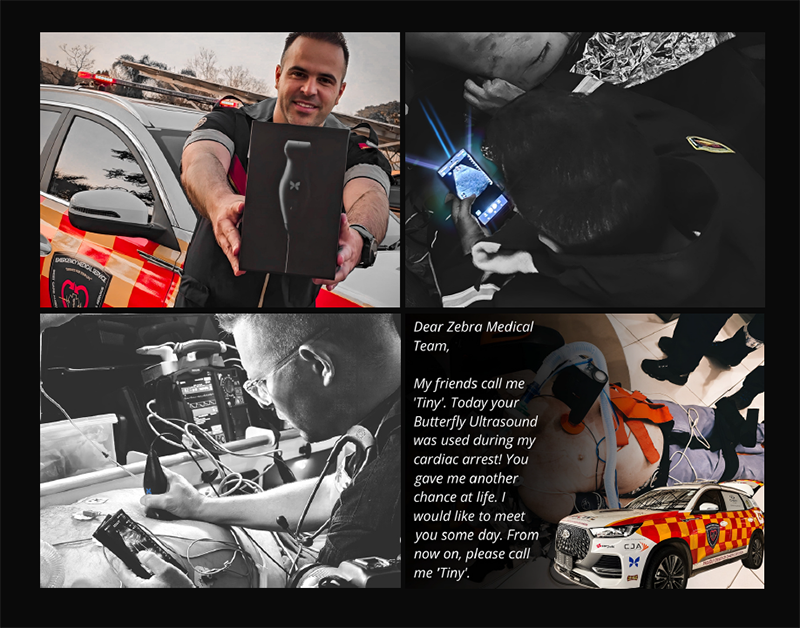
This newsletter focuses on our roadside heroes, the first responders, who increasingly are wielding their ButterflyIQ+ probes in helping them make these really difficult decisions often in the most extreme and pressurised scenarios.

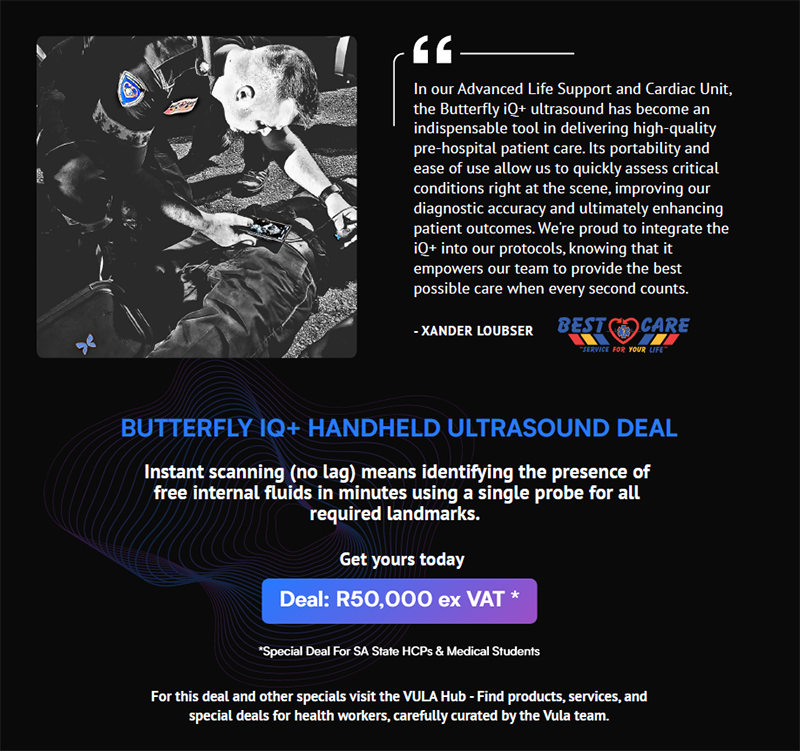
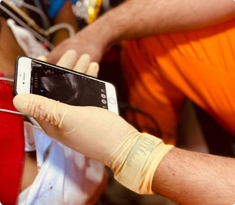
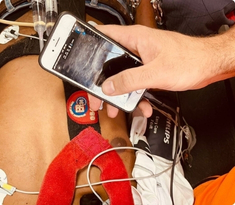
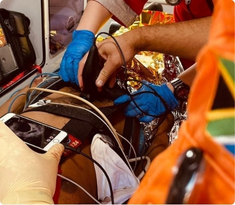
The ability for them to perform an e-FAST scan right on the side of the road with their ButterflyIQ+ means uncertainty becomes certainty in a few minutes. Lifesaving minutes. They can instantly turn a smartphone into a high-tech diagnostic window, allowing them to:

  • Detect internal bleeding in the abdomen or around the heart within seconds.
  • Identify pneumothoraxes and haemothoraxes immediately at the scene.
  • Make life-saving decisions regarding fluid resuscitation and transport destination before the ambulance even moves.

The stories we are sharing in this edition are a tribute to all of our first responders, that midnight call, jump into their vehicles and race to save lives, without hesitation and often on a pro bono basis. We thank each one of you.

Our message to you this December is simple: Please be safe on our roads.

“ScanLab has been a complete game-changer in how I teach and learn POCUS. Using the ScanLab AI, we’ve been able to train students to reliably acquire correct views for E-FAST, basic echocardiography and lung ultrasound, and the excitement it’s generated among students is tangible. Personally, it’s transformed how I engage in the hospital setting – instead of passively observing, I can actively participate in real-time discussions with registrars and consultants about ultrasound findings and management. The learning advantage this gives students is undeniable.”

– JONTY WRIGHT, MBCHB V

Warm regards and safe travels,

How ROCKET HEMS Uses Butterfly Ultrasound in Practice

ROCKET HEMS operates three bases with four active helicopters, and every aircraft carries a Butterfly ultrasound device as standard critical care equipment. This forms part of our clinical governance framework and supports our commitment to evidence-based decision-making across all mission types.

In the helicopter environment – where noise, vibration and space constraints often make traditional assessment tools difficult – ultrasound becomes a decisive, high-fidelity source of information. The Butterfly iQ/iQ+ platform offers excellent image quality, reliability, and portability, and its combination of affordability and robust performance makes it the ideal solution for our high-acuity retrieval environment.

Why Butterfly Works in HEMS

In helicopter retrieval medicine, auscultation is frequently impossible. Rotor noise, restrictive PPE, patient packaging, and confined cabin dimensions mean we cannot rely on a stethoscope alone. Sonography gives us back the ability to “hear” what we cannot hear, using visualisation rather than sound to guide major decisions.

How We Use Butterfly Ultrasound in Practice

Across all four machines and at all bases, ROI from ultrasound is seen daily in:

Trauma
  • EFAST for rapid detection of pneumothorax, haemothorax, pericardial effusion, or intra-abdominal bleeding.
  • Confirmation of tube placement or lung sliding when auscultation is not possible.
  • Monitoring for evolving chest pathology during flight.
Medical Emergencies
  • Cardiac ultrasound for global function, tamponade, shock type differentiation.
  • IVC assessment guiding fluid vs. pressor therapy.
  • Pulmonary ultrasound for differentiating causes of respiratory distress.
Procedural
Guidance
  • Vascular access in difficult environments.
  • When we have a doctor on the machine – it’s easier to provide excellent pain management when we can provide regional nerve blocks for the right patients.

Integration into the ROCKET Clinical Governance System

Routine use of ultrasound by all crews supports several arms of our clinical governance model:

  • Patient safety: ultrasound findings are documented on the PRF as part of the objective assessment, including EFAST and lung findings.
  • Quality assurance: PRF reviewers track ultrasound usage as part of skill maintenance and performance benchmarking.
  • Training: ongoing ultrasound training is mandated for the team and forms part of annual competency maintenance requirements — what we practice we get better at!

Impact on Patient Care

Using Butterfly ultrasound on every machine allows ROCKET to:

  • Make earlier, more accurate clinical decisions.
  • Reduce cognitive uncertainty in chaotic environments.
  • Guide safe, physiologically sound treatments.
  • Deliver a more reliable, standardised critical care offering across all bases.

By embedding point-of-care ultrasound into every mission, ROCKET ensures that every patient benefits from the same high-quality diagnostic capability, regardless of the base, aircraft, or clinical crew on duty.

– KALEB LACHENICHT